

You started Mounjaro to lose weight, and the scale is finally moving. But your arms feel weaker when lifting grocery bags, climbing stairs leaves you winded, and the face staring back in the mirror looks thinner—but not healthier. This isn't what you signed up for.
The key to preserving muscle while taking Mounjaro is combining resistance training at least twice weekly with adequate protein intake (0.7–1 gram per pound of body weight daily), which research shows can reduce lean mass loss by up to 50% compared to medication alone. Without this strategic approach, studies indicate that 25–40% of weight lost on GLP-1 medications like Mounjaro comes from muscle rather than fat—a concerning ratio that accelerates aging and metabolic decline.
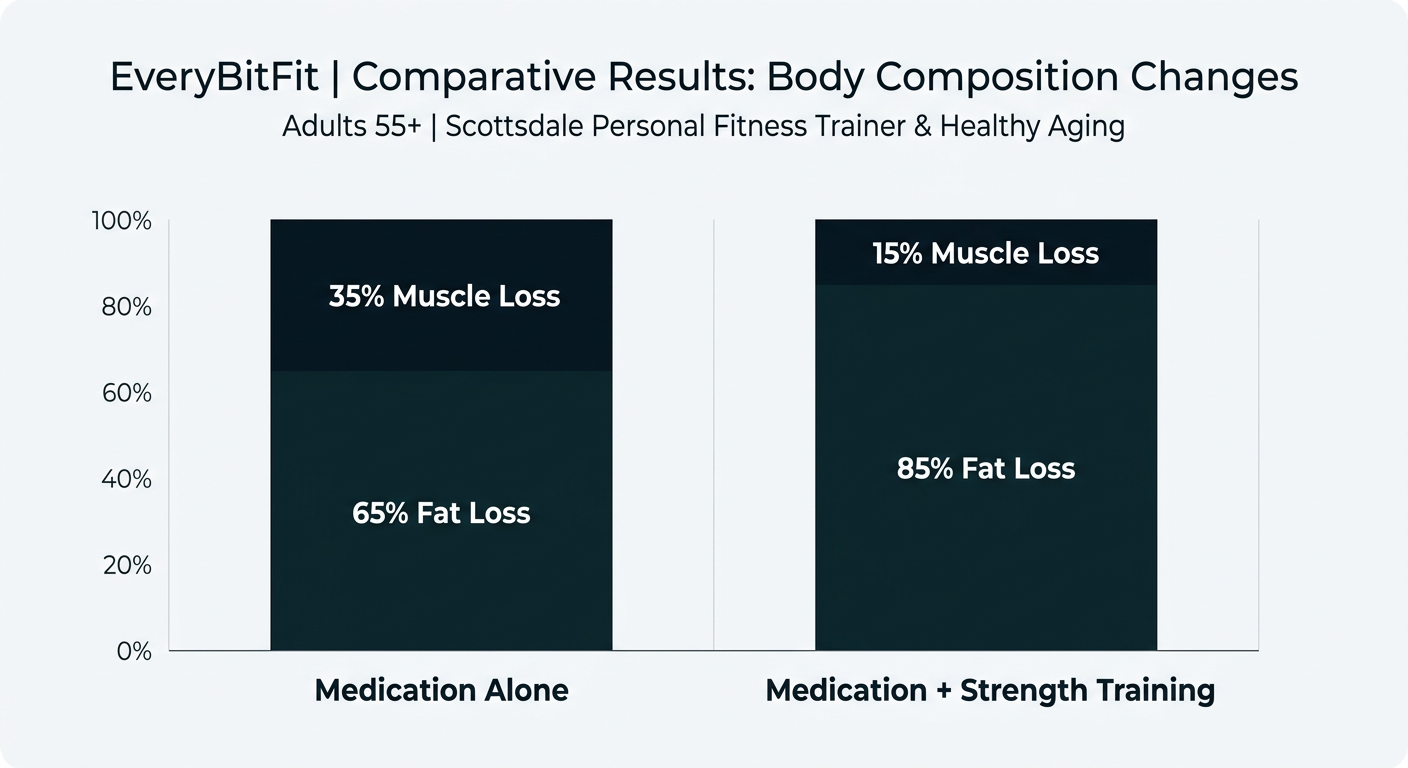
Research shows that combining strength training with GLP-1 medications can reduce muscle loss by up to 50%.
At Everybitfit's GLP-1 workout programs in Scottsdale, we've helped dozens of clients navigate this exact challenge. This guide covers the science behind Mounjaro-related muscle loss, the specific training protocols that protect your strength, and practical strategies you can implement starting today.
Why Mounjaro Causes Muscle Loss—and Why It Matters
Mounjaro (tirzepatide) works by mimicking two gut hormones—GLP-1 and GIP—that regulate appetite, blood sugar, and metabolism. The result? Significant appetite suppression that creates a calorie deficit, often leading to rapid weight loss. Clinical trials published in the New England Journal of Medicine showed participants losing an average of 20–25% of their body weight over 72 weeks.
Here's the problem: your body doesn't selectively burn fat. When you consume significantly fewer calories than you need—especially without adequate protein and strength training—your body breaks down muscle tissue for energy alongside fat stores. This process, called catabolism, happens faster during rapid weight loss.
For adults over 55, this muscle loss compounds an existing challenge. After age 30, we naturally lose 3–8% of muscle mass per decade, according to the American College of Sports Medicine. Add medication-induced calorie restriction on top of this natural decline, and you're looking at accelerated muscle wasting that affects:
Metabolic rate—each pound of muscle burns approximately 6 calories at rest compared to 2 calories per pound of fat, so losing muscle slows your metabolism
Functional strength—the ability to carry groceries, get up from chairs, and maintain independence
Bone density—muscles pulling on bones during movement stimulate bone-building cells; less muscle means weaker bones
Balance and fall risk—weakened leg muscles and reduced proprioception increase fall likelihood
The goal isn't to avoid weight loss—it's to ensure the weight you lose comes primarily from fat, not the muscle tissue that keeps you strong, active, and metabolically healthy.
How Everybitfit Designs Muscle-Preservation Programs for Mounjaro Users
At our Scottsdale personal training studio, we've developed a specific protocol for clients taking Mounjaro, Ozempic, Wegovy, and Zepbound. This isn't a modified version of a standard weight-loss program—it's a muscle-first approach that recognizes GLP-1 medications change the rules.
Every client starts with a comprehensive assessment including body composition analysis, functional movement screening, and a detailed conversation about their medication timeline, current protein intake, and energy levels. Because appetite suppression is the whole point of Mounjaro, we can't assume clients will naturally eat enough to support muscle maintenance.

Personalized, supervised strength training ensures safety and effectiveness for Scottsdale seniors on GLP-1 medications.
Our certified trainers—both male and female—then build customized programs around three pillars:
Progressive resistance training forms the foundation. We prioritize compound movements that work multiple muscle groups simultaneously: squats, deadlifts, rows, presses, and loaded carries. These exercises provide the strongest muscle-preservation stimulus per minute of training. Research from the Journal of Strength and Conditioning Research confirms that resistance training during caloric restriction preserves significantly more lean mass than cardio or diet alone.
Nutritional coaching comes integrated with every training package—not sold separately. Our trainers help you hit protein targets even when your appetite has disappeared, suggesting timing strategies (eating protein-rich meals earlier in the day when appetite is higher), texture modifications (smoothies and softer proteins when solid food feels impossible), and simple tracking methods.
Energy management acknowledges the reality of training on reduced calories. We adjust workout intensity and volume based on how you're feeling week to week, ensuring you can train consistently without burnout or injury.
Ready to protect your strength while losing weight? Our GLP-1 muscle-preservation program is designed specifically for Mounjaro and Ozempic users. Claim your free fitness strategy session and workout to see how personalized training makes the difference, or call (602) 743-6867 to speak with a trainer today.
5 Mounjaro Muscle Retention Tips You Can Start Today
Whether you work with a trainer or train independently, these evidence-based strategies will help protect your lean mass throughout your Mounjaro journey.
1. Prioritize Protein at Every Meal
Aim for 0.7–1 gram of protein per pound of your target body weight daily—not your current weight. For a 180-pound person targeting 150 pounds, that's 105–150 grams of protein daily. Spread this across 4–5 smaller meals rather than trying to consume large portions your reduced appetite can't handle.
Good options when appetite is low: Greek yogurt, cottage cheese, protein smoothies with unflavored whey or collagen, scrambled eggs, and deli turkey. Our diets and recipes resource includes high-protein options designed for reduced appetites.
2. Lift Weights at Least Twice Weekly
Two full-body strength sessions per week is the minimum threshold for muscle preservation during caloric restriction. Three sessions is ideal if recovery allows. Each session should include:
A squat or leg press variation (quadriceps, glutes)
A hip hinge like Romanian deadlifts or hip thrusts (hamstrings, glutes)
A horizontal pull like rows (back, biceps)
A horizontal push like bench press or push-ups (chest, triceps, shoulders)
A vertical pull or push (lat pulldowns, overhead press)
This is exactly the structure our strength training classes follow, ensuring every major muscle group receives stimulus each session.
3. Train Heavy Enough to Challenge Your Muscles
Light weights for high reps won't provide sufficient muscle-preservation stimulus. Aim for weights that challenge you in the 6–12 rep range, where the last 2–3 reps feel difficult but form remains solid. If you can easily complete 15 reps, the weight is too light to signal your body to preserve muscle tissue.
For clients new to strength training—or those returning after years away—our trainers scale appropriately while still ensuring progressive challenge. Building to heavier loads happens gradually and safely.
4. Time Your Protein Around Training
Consuming 20–40 grams of protein within two hours after strength training maximizes muscle protein synthesis—the process by which your body repairs and builds muscle tissue. A post-workout shake or a chicken breast with vegetables works equally well; the key is consistency.
If you train in the morning and your appetite is suppressed, a liquid protein source like a shake is easier to consume than solid food.
5. Don't Slash Calories Beyond What Mounjaro Already Reduces
One mistake we see regularly: clients on Mounjaro deliberately restricting calories even further, thinking faster weight loss is better. Mounjaro already creates a substantial caloric deficit through appetite suppression. Adding aggressive dietary restriction on top increases muscle loss risk significantly.
Work with your healthcare provider and a qualified trainer to ensure your total calorie intake supports basic metabolic function and training recovery—usually no lower than 1,200 calories for women or 1,500 for men, though individual needs vary.
Can You Build Muscle While Taking Mounjaro?
Yes, though expectations should be realistic. True muscle building (hypertrophy) typically requires a calorie surplus—eating more than you burn—which contradicts the weight-loss goal of Mounjaro treatment. However, muscle maintenance and even modest gains are absolutely achievable, especially for beginners or those returning to strength training after extended breaks.
This phenomenon, sometimes called "newbie gains," occurs because untrained muscles respond dramatically to novel stimulus. Someone who hasn't lifted weights in years may actually add measurable muscle while losing fat during their first 3–6 months of consistent training—even in a calorie deficit.
At Everybitfit, we've seen this pattern repeatedly with our senior personal training clients. A 62-year-old woman who started Wegovy while beginning strength training with us lost 35 pounds over six months and gained 4 pounds of lean mass according to her body composition scans. Her arms and legs became more defined even as her overall weight dropped.
The key was consistent resistance training twice weekly, protein intake above 100 grams daily, and patience.
How Long Does It Take to See Results?
Body composition changes become measurable within 8–12 weeks of consistent strength training and adequate protein intake. You'll likely feel changes sooner—improved energy, easier daily movements, better sleep—within the first month.
The scale may not reflect these changes accurately. Because muscle is denser than fat, you might lose inches while the scale stays relatively stable, or drops more slowly than expected. This is actually a positive sign that you're preserving lean mass rather than experiencing the rapid muscle-plus-fat loss that leaves people looking "deflated."
We recommend body composition testing (DEXA scans or bioelectrical impedance) every 8–12 weeks rather than relying solely on scale weight. Our trainers can recommend testing facilities near Scottsdale Airpark and help interpret results in context of your training progress.
What Happens If You Don't Strength Train on Mounjaro?
Without resistance training, research suggests 25–40% of weight lost on GLP-1 medications comes from lean mass rather than fat. For someone losing 50 pounds, that could mean losing 12–20 pounds of muscle—the equivalent of aging your body by 15–25 years in terms of functional capacity.
This muscle loss creates several downstream problems:
Metabolic slowdown that makes weight regain more likely if you discontinue medication
The "skinny fat" appearance where you weigh less but still look soft and undefined
Increased fragility and fall risk, particularly concerning for adults over 55
Reduced bone density since muscle contractions stimulate bone-building activity
Our fall prevention training addresses these risks directly, combining strength work with balance and coordination exercises that protect independence as you age.
Frequently Asked Questions
How much protein do I need on Mounjaro to prevent muscle loss?
Research supports consuming 0.7–1 gram of protein per pound of your target body weight daily—significantly higher than the standard recommendation. For example, someone targeting 150 pounds should aim for 105–150 grams daily. Spreading this across multiple smaller meals helps when appetite is suppressed. Our trainers at Everybitfit provide nutritional guidance as part of every training package.
Can I do cardio instead of weights to preserve muscle on Mounjaro?
Cardio does not preserve muscle mass during caloric restriction—only resistance training provides the mechanical stimulus that signals your body to maintain muscle tissue. That said, moderate cardio (walking, cycling) can complement strength training for cardiovascular health and calorie expenditure. Just don't substitute it for weights if muscle retention is your goal.
Does Everybitfit work with clients on GLP-1 medications like Mounjaro?
Absolutely. GLP-1 muscle-preservation programs are one of our specialties at our Scottsdale studio. We've developed specific protocols for clients on Mounjaro, Ozempic, Wegovy, and Zepbound that prioritize lean mass retention while supporting healthy weight loss. Our $99 Jumpstart Special includes 5 private sessions—a perfect way to establish your muscle-preservation foundation.
How soon after starting Mounjaro should I begin strength training?
Ideally, start strength training before or simultaneously with your medication. The sooner you establish the muscle-protective stimulus of resistance training, the less lean mass you'll lose during initial rapid weight loss phases. If you're already several months into treatment, beginning now still provides significant benefits compared to no training.
Is personal training worth it if I'm already losing weight on Mounjaro?
Weight loss and healthy weight loss are different outcomes. Without strategic training, much of your loss will come from muscle—leaving you lighter but weaker, with a slower metabolism. A qualified personal trainer ensures you're losing the right kind of weight while building functional strength for the decades ahead. Our free strategy sessions help you understand exactly what your body needs.
Mounjaro and other GLP-1 medications represent a genuine breakthrough for weight management—but they work best as part of a comprehensive approach that includes resistance training and adequate protein. The goal isn't just to weigh less; it's to be stronger, more functional, and healthier at your new weight.
At Everybitfit, our Scottsdale trainers specialize in helping adults 55+ navigate exactly this challenge. In our private studio—not a crowded gym—you'll get the personalized attention, customized programming, and nutritional guidance that transforms weight loss into genuine health improvement.
Your first workout is free. Book your free fitness strategy session and workout or call (602) 743-6867 to start protecting your strength today.
This article is for informational purposes only and does not constitute medical advice. Consult your physician before beginning any new exercise or nutrition program, especially if you have existing health conditions or are taking prescription medications including GLP-1 agonists. Results vary by individual based on effort, consistency, and adherence to programming. For personalized guidance, contact Everybitfit at (602) 743-6867 or visit everybitfit.com.