
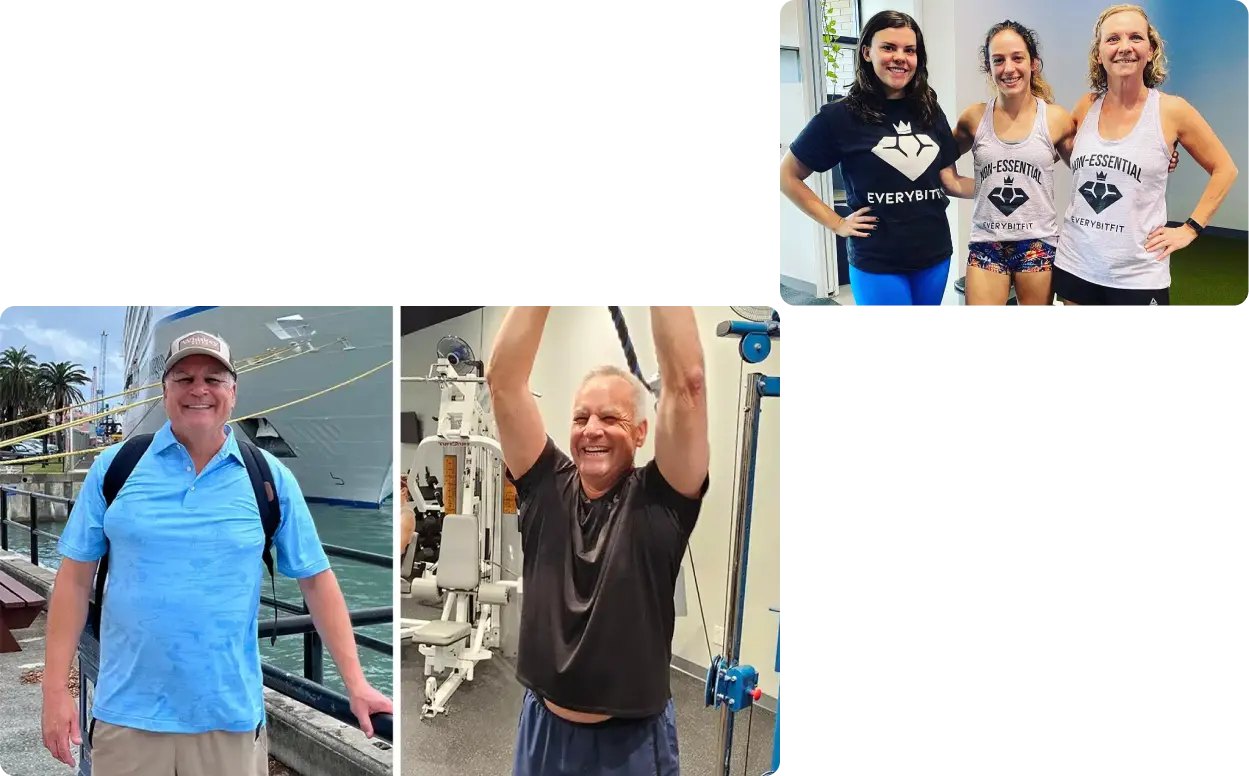
Most people over 40 who ask us about small group training are asking one real question: can I train with other people and still get coaching that fits my body? The honest answer is yes — but only if the group stays small enough that a coach can watch every rep.
Small group training means 2 to 4 people in one coached session, following the same plan with individual modifications to exercises, loads and ranges of motion. It is not a fitness class, and it is not a substitute for private coaching when someone has complex needs.
What small group training actually is
In our Scottsdale studio, a small group session runs like a private personal training session with two to four people in the room. Your coach writes one session structure — for example, a lower body strength block, a pulling block and a balance finisher — and then assigns each person their own version of it.
That means one person might be doing a barbell deadlift while the person beside them does a trap bar deadlift from blocks and a third does a hip hinge to a bench. Same movement pattern, same session, three different entry points.
Why the group size matters more than anything else
Group size is the whole variable. At 2 to 4 people, your coach can see every set, catch a rounding back before it becomes a problem and change the load mid-session. Beyond four, that stops being possible — the coach becomes an instructor at the front of the room, and the session becomes a class.
For adults over 40 this matters more than it does at 25. Tendons take longer to adapt, previous injuries change how a movement should look, and joint history varies wildly from person to person. Supervision is the safety mechanism.
What changes in training after 40
- Muscle mass declines without resistance training. Adults typically lose muscle each decade from their 30s onward unless they train against resistance. That loss drives most of the strength and metabolism changes people blame on age.
- Bone density needs loading. Progressive weight-bearing and resistance work is one of the few things that meaningfully signals bone to maintain itself, which matters especially for women through and after menopause.
- Balance is trainable. Single-leg work, controlled step-downs and loaded carries maintain the reactions that prevent falls later on.
- Recovery is the limiter, not effort. Two to three quality sessions a week, progressed carefully, beats five sessions that leave you sore and inconsistent.
Our training for active adults and seniors is built around exactly these priorities, whether you train privately or in a small group.
Who small group training suits
- You want coaching but you would rather not train completely alone.
- You are motivated by the accountability of other people expecting you.
- Your goals are general strength, body composition, energy and longevity rather than a narrow rehab or performance target.
- Your schedule is flexible enough to fit a fixed group time.
Who is better served by 1-on-1 private coaching
- You are returning from surgery, a joint replacement or a recent injury.
- You have significant pain, mobility limits or medical considerations that need constant hands-on adjustment.
- You are brand new to lifting and want to learn the movements without an audience.
- Your schedule changes week to week.
That is why private 1-on-1 coaching is the default at Everybitfit. Small group is something we recommend after we understand your body and your goals — not a cheaper package you pick from a menu.
What a session looks like
- Movement prep (10 minutes). Joint-specific warm-up based on what each person needs that day — hips, shoulders, ankles.
- Strength block (25–30 minutes). Two to three paired movements, each individually loaded and logged so progression is measurable.
- Conditioning or balance (10 minutes). Carries, sled work, step-ups or low-impact intervals scaled to each person.
- Down-regulation (5 minutes). Breathing and mobility so you leave the studio calm, not wrecked.
Every rep is logged. That log is what makes progression real rather than a workout that just feels hard.
How to decide
The fastest way to know which format fits is a conversation, not a guess. In a free fitness strategy session we look at your history, your schedule and what you want in two years, then tell you honestly whether private coaching or a small group is the better starting point. If you want to see how the formats compare first, our coaching options page lays them out, and the small group training page covers scheduling and availability.