

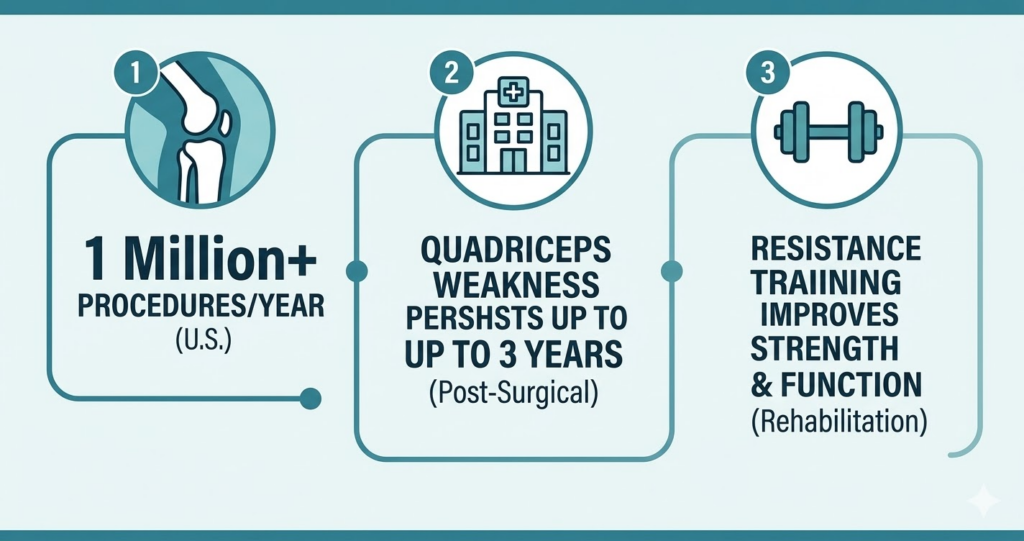
Over one million total hip and knee replacement surgeries are performed every year in the United States, making joint arthroplasty the most common elective surgical procedure in the country. The American Joint Replacement Registry (AJRR) 2024 Annual Report, published by the American Academy of Orthopaedic Surgeons, now captures 4.3 million procedures in its database across 1,447 institutions in all 50 states. These numbers continue to grow — projections from CMS data estimate annual volumes will increase by roughly 25–29% every five years through 2060.
The surgery itself is remarkably successful at eliminating pain and restoring joint function. But here is what most patients do not hear before they go under the knife: the muscles surrounding your new joint will be significantly weaker after surgery — and standard rehabilitation alone often fails to fully restore that strength. A 2024 narrative review published in the European Journal of Sport Science confirmed that muscle-related deficits following total knee arthroplasty (TKA) “persist long after surgery, despite the application of standardized rehabilitation programs.” A 2024 meta-analysis published in PMC found that quadriceps and hip abductor weakness can persist for up to three years following TKA.
This is where a personal trainer becomes essential — and where EveryBitFit in Scottsdale, Arizona delivers results that standard physical therapy often cannot match. Just ask client Barbara K., age 72, who trains at EveryBitFit around her knee replacement: “My trainer at EveryBitFit understands exactly how to work around my knee replacement while still challenging me. I’m stronger now at 72 than I was at 65!”
Why Muscles Weaken After Joint Replacement — and Why Standard Rehab Often Falls Short
The Muscle Loss Problem
Joint replacement surgery is a trauma to the surrounding musculature. Even before surgery, patients with osteoarthritis have already experienced years of progressive muscle weakening due to pain, reduced activity, and joint inflammation. Surgery then compounds the problem.
A 2024 review in the European Journal of Sport Science (Monsegue et al.) documented the cycle: knee osteoarthritis causes deficits in muscle strength, mass, and physical functioning. These deficits are “acutely exacerbated following total knee arthroplasty” and persist even after completing standard rehabilitation programs. For total hip replacement, a 2024 narrative review published in PMC (Singh et al.) confirmed that “THR is associated with improved hip function and quality of life, but this usually takes a long time due to individualized physical therapy interventions.”

No Risk, All gain
Schedule your free workout and consultation
The specific areas of concern include quadriceps weakness (the muscles at the front of the thigh, critical for walking, stair climbing, and rising from a chair), hip abductor weakness (essential for stable gait and balance), reduced range of motion, and diminished balance and proprioception.
The Gap Between Physical Therapy and Full Functional Recovery
Standard post-surgical rehabilitation typically runs 6–12 weeks and focuses on restoring basic range of motion, reducing swelling, and achieving fundamental mobility milestones — walking unassisted, climbing stairs, getting in and out of a car. These are essential goals, and physical therapy is the right intervention for this phase.
But here is the problem: research consistently shows that patients discharged from PT after meeting basic milestones still have significant strength and functional deficits compared to age-matched healthy adults. A 2024 randomized controlled trial published in The Journal of Arthroplasty (Jiao et al.) compared high-intensity progressive rehabilitation versus routine rehabilitation after TKA and found that patients who received progressive training achieved better knee function scores, satisfaction, walking distance, quality of life, and shorter hospital stays.
This gap — between “cleared by PT” and “truly strong and functional” — is precisely where a personal trainer with post-surgery expertise makes the difference.
What the Research Says: Progressive Resistance Training After Joint Replacement
For Knee Replacement
The 2024 European Journal of Sport Science narrative review (Monsegue et al.) synthesized the evidence on resistance exercise training (RET) after total knee arthroplasty and concluded that “adding high-intensity RET to the post-TKA recovery program has the potential to improve physical functioning outcomes to a greater extent than standard rehabilitation alone.”
A 2022 systematic review and meta-analysis published in Frontiers in Sports and Active Living (Jørgensen et al.) analyzed RCTs of pre-operative resistance training before hip or knee replacement and found “moderate-to-large improvements in functional performance and maximal knee extensor strength at 3 months after surgery along with small-to-moderate effects 12 months post-operatively.”
A 2024 meta-analysis published in The Journal of Orthopaedics (Liu et al.) specifically examined progressive resistance training after TKA and confirmed its role in improving early postoperative muscle strength and functional capacity.
For Hip Replacement
The 2024 narrative review by Singh et al. in PMC on muscular strength recovery after total hip replacement found that structured rehabilitation programs incorporating “progressive resistance training, functional exercises, and gait training” are necessary for full recovery. The review noted that “initial mobilization and strict compliance with rehabilitation protocols have been linked to improving outcomes such as muscle strength, range of motion, and functional performance.”
The Role of Prehabilitation
Emerging research also supports training before surgery. A 2024 systematic review in Musculoskeletal Care (Kan et al.) found that structured pre-operative exercise programs — “prehabilitation” — including strength training, balance exercises, and mobility work can enhance post-operative outcomes and accelerate recovery. A meta-analysis published in PMC in 2025 on preoperative high-intensity strength training before TKA confirmed improvements in functional performance and knee extensor strength after surgery.
How EveryBitFit Helps Clients Rebuild After Joint Replacement
EveryBitFit’s private personal training studio in Scottsdale is uniquely positioned to serve joint replacement patients for several reasons documented across their website.
Trainers Who Specialize in Working Around Limitations
Jason is described on EveryBitFit’s trainers page as specializing in “building strength, improving mobility, supporting healthy weight loss, and boosting energy, with personalized plans that adapt to your lifestyle and abilities.” For seniors and those returning to fitness, Jason brings “patience, clear communication, and a positive attitude” designed to help “people move better, feel stronger, and stay independent longer.” This adaptability is exactly what joint replacement recovery demands.
Daphlie “Daph” is a new team member and ISSA Certified Personal Trainer who specializes in helping women 40+ “improve bone density, balance, and overall longevity through safe, progressive strength training.” Her focus on “proper form, steady progress” and creating a “supported and empowered” environment aligns with the careful, progressive loading that post-surgical clients need.
Zach, EveryBitFit’s founder, has been in the fitness industry since 2008 and brings “a diverse background” covering “a wide range of fitness goals.” As the studio’s leader, he sets the standard for the individualized, adaptive approach that defines EveryBitFit.
The Client Who Proves It Works
Barbara K.’s published testimonial is the clearest evidence of EveryBitFit’s post-surgical capabilities. At 72 years old, training around a knee replacement, she reports being “stronger now at 72 than I was at 65.” Her trainer, she says, “understands exactly how to work around my knee replacement while still challenging me.” This is the definition of intelligent, adaptive personal training.
The EveryBitFit Methodology Applied to Joint Replacement Recovery
Step 1: Comprehensive Assessment. A 3D body scan, health history discussion (including surgical history, surgeon’s clearance, and any movement restrictions), goal-setting, and fitness evaluation. EveryBitFit trainers coordinate with healthcare providers to ensure the fitness program complements medical treatment.
Step 2: Personalized Progressive Programming. Based on the assessment, trainers build a custom program that progressively loads the muscles surrounding the replaced joint — quadriceps, hip abductors, glutes, hamstrings, and core — while respecting surgical precautions and range-of-motion guidelines.
Step 3: One-on-One Supervised Sessions. Every session is supervised, ensuring proper form, appropriate progression, and real-time adjustment. The research is clear that supervised, progressive training outperforms unsupervised exercise for post-surgical outcomes.
Step 4: Ongoing Tracking and Adaptation. Regular reassessments measure progress in strength, balance, range of motion, and functional capacity. Programs evolve as the client recovers and grows stronger.
The private studio environment is especially important for joint replacement clients. As EveryBitFit describes, their setting eliminates the anxiety of crowded gyms and provides “a comfortable atmosphere where older adults can focus on fitness without distractions or self-consciousness.” Learn more about personal training for seniors at EveryBitFit.
Practical Guide: Training After Joint Replacement
1. Get surgical clearance. Before beginning any strength training program, obtain written clearance from your orthopedic surgeon. Most surgeons clear patients for progressive exercise 6–12 weeks after surgery, once basic PT milestones are met.
2. Choose a trainer experienced with post-surgical clients. Not all trainers understand surgical precautions, prosthetic limitations, or the progressive loading protocols that research supports. EveryBitFit’s team has documented experience working with joint replacement clients.
3. Start with bodyweight and low-load exercises. The research supports beginning with light resistance and progressively increasing load over time — exactly the approach EveryBitFit follows through their graduated programming model.
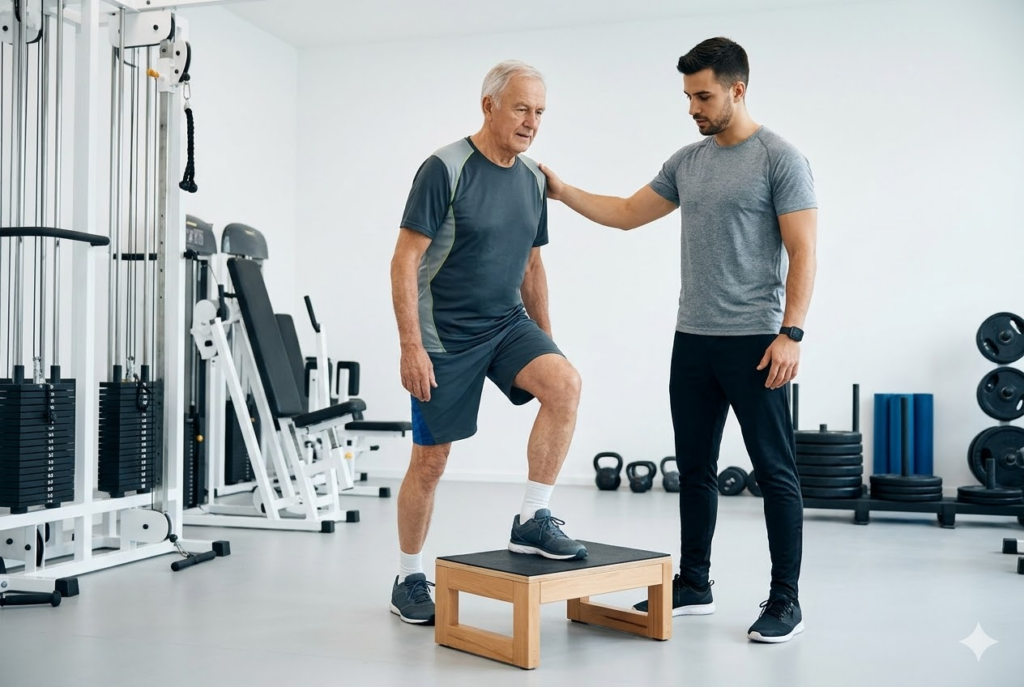
4. Focus on the muscles that surgery weakened most. Quadriceps strengthening (leg press, step-ups, sit-to-stand), hip abductor work, hamstring curls, and core stability exercises are the priorities identified by the research. Balance training should also be included, as joint replacement patients face elevated fall risk during recovery.
5. Train 2–3 times per week. The research on post-surgical resistance training typically uses 2–3 sessions per week as the standard protocol. EveryBitFit recommends the same frequency — 2–3 sessions totaling 90–180 minutes weekly.
6. Be patient with progression. Full functional recovery after joint replacement takes months, not weeks. The 2022 meta-analysis found measurable strength improvements at 3 months with continued gains at 12 months. Consistency matters more than intensity in the early phases.
7. Combine exercise with nutrition. Adequate protein intake supports muscle rebuilding after surgery. EveryBitFit includes nutritional coaching with all programs — critical for joint replacement clients who need to rebuild muscle while managing a healthy weight to protect their new joint.
8. Train in a safe, private environment. Joint replacement clients often feel vulnerable and self-conscious. Discover how a personal trainer transforms your health in a private studio where safety, comfort, and expert guidance come first.
Conclusion
Joint replacement surgery is one of the most successful procedures in modern medicine — but surgery alone does not restore the strength, balance, and functional capacity that osteoarthritis and the surgical process take away. Research consistently shows that progressive resistance training, delivered in a supervised setting, bridges the critical gap between “cleared by PT” and “truly strong and independent.”
At EveryBitFit in Scottsdale, trainers like Jason, Daphlie, and Zach specialize in building individualized programs that work around joint replacements while progressively challenging clients to rebuild what surgery alone cannot. Barbara K. is proof: training around her knee replacement at age 72, she is stronger than she was at 65.
Your next step: Call EveryBitFit at (602) 743-6867 or visit everybitfit.com to schedule a complimentary consultation. Bring your surgeon’s clearance letter, and ask about the $99 Jumpstart Special — five private sessions to experience how expert personal training can transform your recovery.
Frequently Asked Questions (FAQ Schema Ready)
Q1: When can I start personal training after joint replacement?
A: Most orthopedic surgeons clear patients for progressive strength training 6–12 weeks post-surgery, after basic PT milestones are achieved. Always obtain written clearance before starting.
Q2: Is strength training safe after knee or hip replacement?
A: Yes, when properly supervised. A 2024 review in the European Journal of Sport Science confirmed that progressive resistance training improves muscle strength and physical function after TKA. EveryBitFit trainers design programs around surgical precautions.
Q3: How long does it take to regain full strength after joint replacement?
A: Research shows measurable improvements at 3 months, with continued gains at 12 months. Quadriceps weakness can persist up to 3 years without targeted training. Consistent, supervised strength training accelerates recovery.
Q4: Does EveryBitFit work with clients who have joint replacements?
A: Yes. Client Barbara K., age 72, trains at EveryBitFit around her knee replacement and reports being “stronger now at 72 than I was at 65.” Trainers coordinate with healthcare providers as needed.
Q5: What exercises are most important after joint replacement?
A: Research prioritizes quadriceps strengthening (leg press, step-ups), hip abductor work, hamstring exercises, core stability, and balance training. EveryBitFit customizes these movements to each client’s surgical history and recovery stage.
This article references publicly available information from EveryBitFit (everybitfit.com), the American Academy of Orthopaedic Surgeons (AAOS), the American Joint Replacement Registry (AJRR), and peer-reviewed research published in the European Journal of Sport Science, The Journal of Arthroplasty, Frontiers in Sports and Active Living, The Journal of Orthopaedics, Musculoskeletal Care, PMC/PubMed, and Cureus, dated from 2015 through 2025. All metrics and quotes are from documented sources. Results described are specific to the organizations and studies mentioned and may vary based on individual health status, surgical approach, and implementation. This article is for informational purposes only and does not constitute medical advice. Always consult your orthopedic surgeon and medical team before beginning any post-surgical exercise program. For current information about EveryBitFit’s services, visit everybitfit.com or call (602) 743-6867.


