
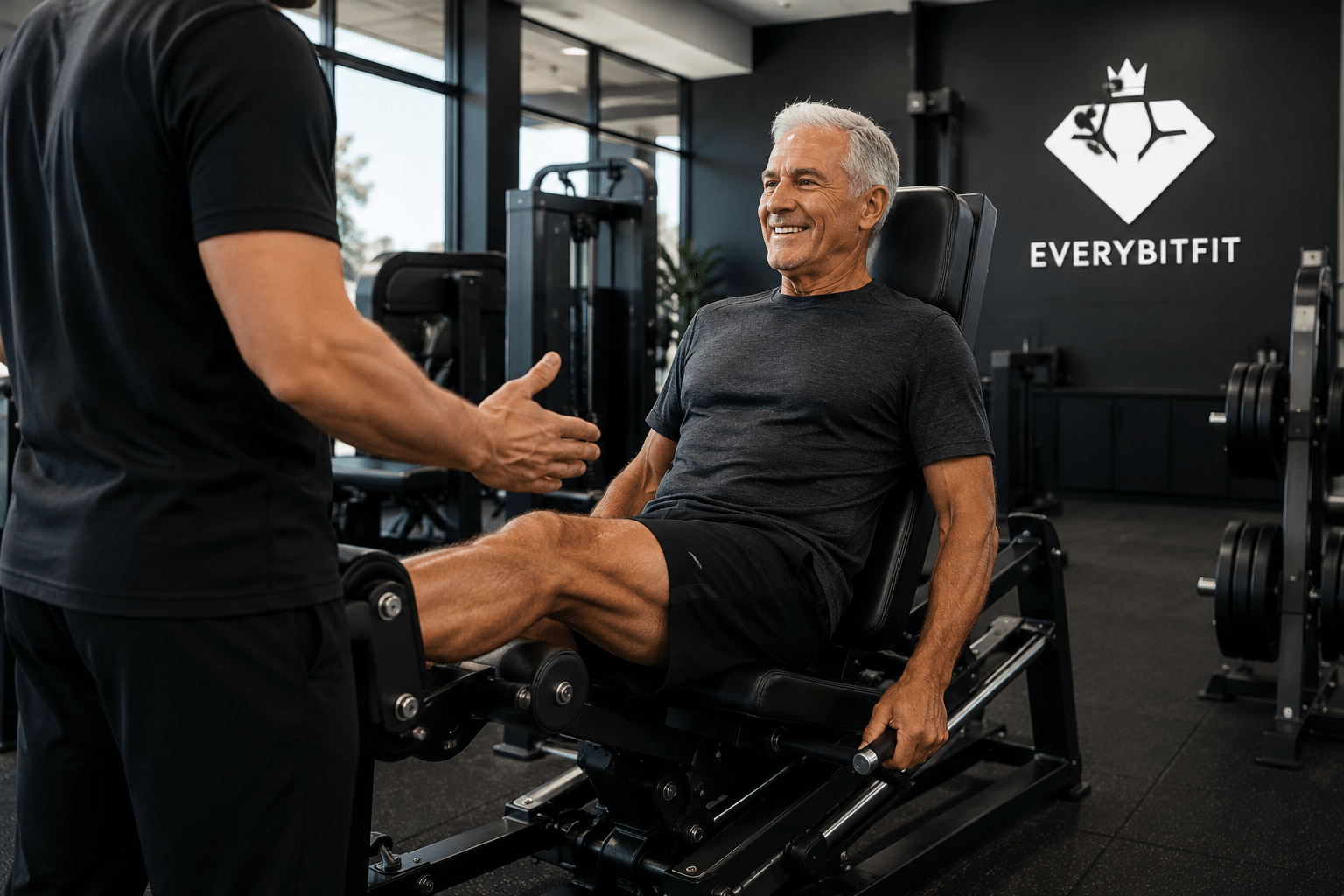
You've been told to "take it easy" now that you're over 55. Maybe a well-meaning doctor suggested walking more, or a friend warned you that lifting weights is dangerous at your age. Here's what the science actually says: Senior strength training is not only safe—it's one of the most important things you can do for your health, independence, and longevity. Research from the American College of Sports Medicine confirms that resistance training improves muscle mass, bone density, balance, and daily function in adults over 55. With proper supervision and progressive programming, seniors can safely build strength at any starting point.
At Everybitfit in Scottsdale, we've worked with hundreds of adults 55+ since 2013—helping them move better, feel stronger, and maintain the independence that matters most. This guide covers everything you need to know about senior strength training: why it works, how to start safely, and what exercises deliver real results.
Why Senior Strength Training Matters: The Science
After age 30, adults lose approximately 3–8% of muscle mass per decade, according to research published in Current Opinion in Clinical Nutrition and Metabolic Care. This process—called sarcopenia—accelerates after 60, contributing to weakness, falls, fractures, and loss of independence.
But here's the critical point most people miss: sarcopenia is not inevitable. It's largely preventable and even reversible with consistent strength training.
What the Research Shows
- Muscle preservation: The CDC recommends muscle-strengthening activities at least 2 days per week for adults 65+. Studies show that seniors who strength train maintain significantly more muscle mass than sedentary peers.
- Bone density: Weight-bearing and resistance exercises stimulate bone remodeling, slowing or reversing bone loss associated with osteoporosis and osteopenia.
- Fall prevention: Stronger leg muscles and improved balance reduce fall risk by up to 40% in older adults, according to meta-analyses in the British Journal of Sports Medicine.
- Metabolic health: Muscle tissue burns more calories at rest than fat tissue. Building muscle increases your resting metabolic rate, making weight management easier.
- Cognitive function: Emerging research links resistance training to improved memory, attention, and reduced risk of cognitive decline.
The message is clear: strength training isn't just for young athletes. For seniors, it's medicine.
How Everybitfit Approaches Senior Strength Training
Big-box gyms weren't designed for adults over 55. Crowded floors, confusing machines, and cookie-cutter programs that treat a 65-year-old retiree the same as a 25-year-old athlete—that's not training, it's a liability waiting to happen.
At Everybitfit, we built our private Scottsdale studio specifically for people who need something different.
What Makes Our Senior Training Different
- Private, non-intimidating environment: No crowds, no judgment, no waiting for equipment. Just you and your trainer in a space designed for focused work.
- Customized programming: Every program is built around your body, your goals, your medical history, and your schedule. We account for joint issues, past injuries, osteoporosis concerns, balance challenges, and medications.
- Progressive overload done safely: We start where you are—even if that's bodyweight exercises or resistance bands—and progress systematically as your strength improves.
- Integrated nutritional coaching: Muscle doesn't build without proper nutrition. Our programs include guidance on protein intake, hydration, and eating patterns that support muscle preservation—especially important for seniors and those on GLP-1 medications like Ozempic or Wegovy.
- Male and female trainers: We match you with the right trainer based on your goals, comfort level, and availability.
Since 2013, we've helped Scottsdale seniors build strength they didn't think possible—and do it without injury, intimidation, or confusion.
Ready to see what personalized senior training feels like? Claim your Free Fitness Strategy + Workout—5 private training sessions to prove it works. No contract, 30-day money-back guarantee. Call (602) 743-6867 or get started online.
Senior Strength Training Exercises: What Actually Works
Effective senior strength training doesn't require complicated equipment or risky movements. The best exercises are functional—meaning they build strength for movements you actually use in daily life: standing up from a chair, climbing stairs, carrying groceries, catching yourself if you trip.
Lower Body: The Foundation of Independence
- Goblet squats or chair squats: Builds the leg and hip strength you need to stand up independently. Start by sitting and standing from a sturdy chair; progress to weighted goblet squats.
- Step-ups: Mimics stair climbing. Use a low step (4–6 inches) and progress higher as strength improves.
- Romanian deadlifts: Strengthens the posterior chain—glutes, hamstrings, lower back—for better posture and reduced back pain. Start with bodyweight or light dumbbells.
- Calf raises: Often overlooked, but crucial for balance and walking stability.
Upper Body: Functional Pushing and Pulling
- Chest press or push-ups (modified): Builds the pushing strength needed to get up from the floor or push a heavy door.
- Seated rows or resistance band rows: Strengthens the back muscles that keep you upright and counteract rounded "desk posture."
- Overhead press: Maintains the ability to reach overhead—putting away dishes, getting items from shelves.
Core and Balance
- Pallof press: Anti-rotation core exercise that builds stability without stressing the spine.
- Dead bug: Safe core strengthening that teaches your trunk to stabilize while your limbs move.
- Single-leg stance progressions: Simple balance practice that reduces fall risk.
This is exactly the kind of programming our trainers build into every active adults and seniors program—exercises selected for your body, progressed at your pace.
How Often Should Seniors Do Strength Training?
The CDC and ACSM recommend at least 2 days per week of muscle-strengthening activities for adults 65 and older. However, many seniors see better results with 3 sessions per week, especially when starting a new program.
Here's what an effective weekly schedule might look like:
- 2–3 strength sessions: 30–45 minutes each, with at least one rest day between sessions targeting the same muscle groups
- 2–3 days of light cardio or walking: Supports cardiovascular health and recovery
- Daily mobility work: 5–10 minutes of stretching or gentle movement to maintain joint range of motion
Consistency matters more than intensity. Two well-designed sessions per week, done every week, will produce far better results than sporadic intense workouts followed by weeks of inactivity.
Can You Build Muscle After 60?
Absolutely. While muscle building may occur more slowly than it did at 25, research consistently shows that adults in their 60s, 70s, and even 80s can gain significant muscle mass and strength with proper training.
A landmark study in the Journal of Applied Physiology found that men and women aged 60–75 who followed a 12-week strength training program increased their muscle strength by 40–50%—gains comparable to those seen in younger adults.
The keys to building muscle after 60:
- Progressive overload: Gradually increasing the weight, reps, or difficulty of exercises over time
- Adequate protein: Older adults often need more protein than younger people—aim for 0.7–1.0 grams per pound of bodyweight daily
- Sufficient recovery: Sleep and rest days are when muscle actually builds
- Consistency: Results come from what you do repeatedly, not occasionally
If you're on a GLP-1 medication like Ozempic, Wegovy, Mounjaro, or Zepbound, strength training becomes even more critical. These medications can cause muscle loss alongside fat loss; resistance training helps preserve the muscle you need for strength, balance, and metabolic health.
What Exercises Should Seniors Avoid?
There's no universal list of "forbidden" exercises for seniors—what matters is matching the exercise to the individual's current abilities, joint health, and medical history. That said, some movements carry higher risk for older adults without proper preparation or supervision:
- Heavy barbell exercises without instruction: Back squats and deadlifts are excellent exercises, but require proper technique. Work with a qualified trainer before loading a barbell.
- High-impact plyometrics: Box jumps and jumping lunges stress joints. Lower-impact alternatives provide similar benefits with less risk.
- Exercises that cause pain: Pain is information. If a movement hurts, stop—there's almost always a modification that works better for your body.
- Unsupervised max-effort lifts: Testing your one-rep max without a spotter or trainer increases injury risk.
The goal isn't to avoid challenging yourself—it's to challenge yourself intelligently. At Everybitfit, we find the exercises that work for your body and progress them as you get stronger.
Getting Started: Your Next Step
Senior strength training isn't about becoming a bodybuilder or recapturing your 25-year-old physique. It's about preserving the strength, balance, and independence that let you live the life you want—playing with grandchildren, traveling, gardening, staying in your home, and moving through the world without fear of falling.
The science is clear. The benefits are proven. The only question is whether you'll start.
At Everybitfit, we've helped Scottsdale seniors transform their strength and confidence since 2013. Our private studio near Scottsdale Airpark offers one-on-one training designed specifically for adults 55+, with programs customized to your goals, your body, and your life.
Your first workout is free. Call (602) 743-6867 or claim your Free Fitness Strategy + Workout—5 private training sessions, no contract, 30-day money-back guarantee. Come see what personalized training feels like.
Frequently Asked Questions
Is strength training safe for seniors?
Yes, strength training is safe and recommended for seniors when done with proper form and appropriate progression. The CDC and ACSM recommend at least 2 days per week of muscle-strengthening activities for adults 65+. Working with a qualified trainer ensures exercises match your current abilities and health status.
How often should a 70-year-old lift weights?
Most adults over 70 benefit from 2–3 strength training sessions per week, with at least one rest day between sessions. Consistency matters more than duration—30–45 minute sessions done regularly produce better results than occasional intense workouts.
Can you build muscle after 65?
Absolutely. Research shows adults in their 60s, 70s, and 80s can gain significant muscle mass with consistent training. Studies in the Journal of Applied Physiology found older adults achieved strength gains of 40–50% with proper programming—comparable to younger populations.
Does Everybitfit offer training for seniors in Scottsdale?
Yes. Everybitfit's Active Adults & Seniors program provides customized one-on-one training for adults 55+ in our private Scottsdale studio. Programs address balance, bone density, muscle preservation, and functional strength. Call (602) 743-6867 to learn more.