
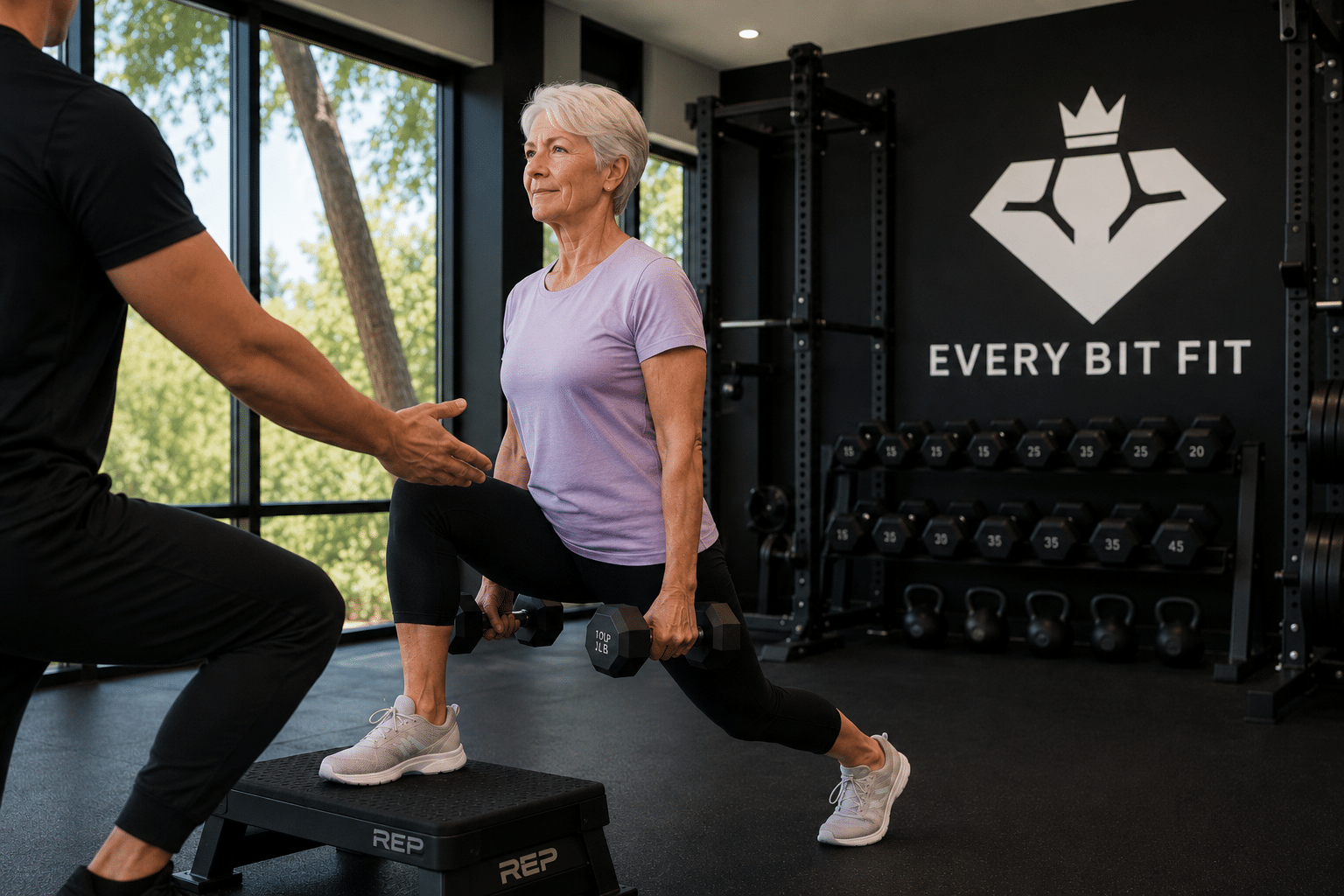
You've just received an osteoporosis diagnosis, and suddenly every movement feels risky. Should you exercise more—or less? Will strength training help your bones or hurt them? If you're in Scottsdale and wondering how to stay active without increasing your fracture risk, you're asking the right questions.
The best osteoporosis exercises combine weight-bearing activities like walking and stair climbing with progressive resistance training using dumbbells, resistance bands, or body weight. These exercises stimulate bone-building cells called osteoblasts while improving muscle strength, balance, and posture—reducing fracture risk by up to 40% when performed consistently under proper supervision.
At Everybitfit in Scottsdale, our trainers specialize in bone-density programs designed specifically for adults managing osteoporosis and osteopenia. This article covers the science behind bone-safe exercise, which movements build density without risking fractures, and practical tips you can start using today.
The Science Behind Osteoporosis Exercises
Your bones are living tissue—constantly breaking down and rebuilding through a process called remodeling. When you have osteoporosis, breakdown outpaces rebuilding, leaving bones porous and fragile. But here's what many people don't realize: exercise is one of the most powerful tools for tipping that balance back toward bone formation.
When muscles pull against bones during weight-bearing and resistance exercises, they create mechanical stress that signals osteoblasts (bone-building cells) to get to work. According to the National Institutes of Health, this process—called mechanotransduction—explains why sedentary lifestyles accelerate bone loss while active lifestyles preserve and even increase bone density.
The research is clear: a meta-analysis published in the Journal of Bone and Mineral Research found that combined resistance and impact training improved hip bone mineral density by 1-2% annually in postmenopausal women—significant when you consider that untreated osteoporosis causes 1-2% bone loss per year.
Why Generic Gym Programs Fall Short
Here's the problem with cookie-cutter fitness programs: they don't account for spinal compression risk, balance deficits, or the specific movement modifications someone with osteoporosis needs. A standard gym routine might include loaded spinal flexion (think: weighted crunches or seated rows with a rounded back)—movements that can actually increase vertebral fracture risk in someone with low bone density.
That's why personalized programming matters so much for this population. What works for a 35-year-old with healthy bones could be dangerous for a 65-year-old with osteopenia. Exercise type, load progression, and movement quality all need to be tailored to your specific bone health status, fracture history, and current fitness level.
How Everybitfit Approaches Bone-Density Training
At Everybitfit's private Scottsdale studio, osteoporosis exercise isn't a one-size-fits-all protocol. Our trainers begin with a thorough consultation that includes your DEXA scan results, fracture history, mobility assessment, and personal goals. From there, we build a progressive program that safely challenges your bones without putting you at risk.
What Makes Our Approach Different
Private, one-on-one supervision: Every rep, every movement, every weight selection is monitored. No crowded gym floor where you're guessing at proper form. No group class where the instructor can't see your spinal alignment.
Progressive overload with safety guardrails: Building bone density requires gradually increasing the challenge to your skeletal system—but that progression needs to be strategic. Our trainers know when to add load and when to modify based on how your body responds.
Balance and fall prevention integrated: For someone with osteoporosis, preventing falls is just as important as building bone. Every program includes proprioception work, single-leg stability training, and reaction-time exercises that reduce your fall risk by up to 40%.
Nutritional coaching included: Calcium absorption, vitamin D levels, protein intake—these all affect bone health. Our integrated nutritional coaching addresses the dietary factors that support (or undermine) your exercise efforts.
We have both male and female trainers available, matched to your goals and comfort level. And because we've been serving Scottsdale since 2013, we've worked with hundreds of clients managing osteoporosis and osteopenia—we know what works.
Ready to see what bone-safe training feels like? Claim your Free Fitness Strategy + Workout—5 private sessions to experience personalized training designed for your body. No contracts, 30-day money-back guarantee. Call (602) 743-6867 or get started online.
The Best Osteoporosis Exercises You Can Start Today
While nothing replaces supervised, personalized training for someone with bone loss, these evidence-based exercises form the foundation of effective osteoporosis programming. Start conservatively and progress gradually—or better yet, work with a qualified trainer who can ensure proper form.
Weight-Bearing Exercises
These exercises force your body to work against gravity while staying upright, directly loading your spine and hips—the two areas most vulnerable to osteoporotic fractures.
- Walking: Brisk walking (not strolling) for 30+ minutes most days. Add inclines or stairs for greater bone stimulus.
- Stair climbing: One of the most bone-friendly activities. Use a handrail if needed for balance.
- Low-impact aerobics: Dance-based fitness, step aerobics (low step height), or elliptical training with upright posture.
- Tai Chi: Improves balance and reduces fall risk by up to 50% according to multiple studies—critical for fracture prevention.
Resistance Training Exercises
Muscle-strengthening exercises create the mechanical loading that triggers bone formation. Focus on major muscle groups with proper alignment.
- Squats (bodyweight or goblet): Load the hips and spine safely. Keep your chest up and spine neutral—no rounding.
- Deadlift variations: Hip hinges with dumbbells or kettlebells strengthen the posterior chain while maintaining spinal integrity.
- Rows (standing or supported): Upper back strength with a neutral spine. Avoid seated rows with spinal flexion.
- Overhead press: Shoulder and upper back loading. Start light and progress gradually.
- Step-ups: Unilateral leg strength plus hip loading. Use a step height appropriate to your mobility.
Balance and Posture Work
Preventing the fall is just as important as strengthening the bone. These exercises build the stability and body awareness that keep you upright.
- Single-leg stands: Progress from holding a wall to unsupported, then add head movements or eyes closed.
- Heel-to-toe walking: Walk in a straight line placing heel directly in front of toes—challenges your vestibular system.
- Wall angels: Strengthen postural muscles that combat the forward-rounding posture common with osteoporosis.
This is exactly the kind of progressive, individualized approach our trainers at Everybitfit build into every client's bone-density program—scaled to your starting point and advanced as you get stronger.
Can You Reverse Osteoporosis with Exercise?
Exercise alone cannot fully reverse osteoporosis, but it can significantly slow bone loss, improve bone density in specific areas, and—critically—reduce fracture risk through better balance and muscle strength. Research from the American College of Sports Medicine shows that high-intensity resistance training can increase spinal bone density by 1-3% annually in postmenopausal women.
The real goal isn't necessarily reversing your DEXA scan numbers—it's staying strong, mobile, and fracture-free for decades to come. That requires consistent, progressive training combined with proper nutrition and, for many people, appropriate medical treatment. Our active adults and seniors program addresses all these factors together.
What Exercises Should You Avoid with Osteoporosis?
Not all exercises are safe when you have compromised bone density. Certain movements place excessive stress on vulnerable areas—particularly the spine—and should be modified or eliminated from your routine.
Avoid or modify these movements:
- Loaded spinal flexion: Sit-ups, crunches, and any exercise that rounds your spine under load. These compress vertebrae and increase fracture risk.
- High-impact activities: Running, jumping, and high-impact aerobics may be too jarring for fragile bones—especially if you're newly diagnosed or have had previous fractures.
- Deep twisting under load: Rotational movements with weight can stress the spine. Modify with neutral-spine alternatives.
- Forward bending to pick up weights: Always hinge at the hips with a flat back rather than rounding to grab dumbbells.
A qualified personal trainer who understands osteoporosis will automatically modify exercises and cue proper alignment—that's what supervision is for.
How Often Should Someone with Osteoporosis Exercise?
For bone-building benefits, the research supports resistance training 2-3 times per week with at least 48 hours between sessions for the same muscle groups. Weight-bearing cardio like walking can be done daily. Balance training should be integrated into every workout or practiced separately 3+ times weekly.
Consistency matters more than intensity when you're starting out. Our trainers at Everybitfit design sustainable programs that fit your schedule and build habits that last—because the real results come from months and years of steady work, not a few intense weeks followed by burnout.
Conclusion
Osteoporosis doesn't mean sitting on the sidelines—it means training smarter with the right guidance. The best osteoporosis exercises combine weight-bearing activities, progressive resistance training, and balance work, all performed with proper form under qualified supervision. At Everybitfit in Scottsdale, we specialize in exactly this: bone-safe, results-driven training for adults who refuse to let a diagnosis define their future.
Your first workout is free. Call (602) 743-6867 or claim your Free Fitness Strategy + Workout—5 private sessions with a trainer who understands bone health. No contracts, 30-day money-back guarantee.


