You've probably heard the phrase "use it or lose it" — and nowhere is that more true than with your bones. Here in Scottsdale, we see it all the time: active adults who assumed their bones were fine until a DEXA scan revealed osteopenia or osteoporosis. The good news? Bone density workouts that combine weight-bearing exercises with resistance training stimulate bone remodeling and increase mineral density. For adults over 50, supervised strength training 2–3 times weekly has been shown to slow bone loss and reduce fracture risk by up to 40%. At Everybitfit, our Scottsdale trainers specialize in safe, personalized bone-density programs for adults 55+. This guide covers the science, the exercises, and exactly how to start protecting your skeleton today.
The Science Behind Bone Density and Exercise
Your bones aren't static structures — they're living tissue that constantly breaks down and rebuilds. This process, called bone remodeling, responds directly to the mechanical stress you place on your skeleton. When you load your bones through weight-bearing movement and resistance training, specialized cells called osteoblasts get the signal to deposit new bone mineral.
According to the American College of Sports Medicine, adults lose approximately 1–2% of bone mass per year after age 50 — and post-menopausal women can lose up to 3–5% annually in the first years after menopause due to declining estrogen. This accelerated loss is why osteoporosis affects an estimated 10 million Americans, with another 44 million showing low bone density.
But here's what the research shows: targeted exercise can slow — and in some cases reverse — this decline. A landmark study published in the Journal of Bone and Mineral Research found that high-intensity resistance training increased bone density at the spine and hip in postmenopausal women with low bone mass. The key factors were progressive overload (gradually increasing the challenge) and specificity (loading the bones you want to strengthen).
The two categories of exercise most effective for bone health are:
- Weight-bearing aerobic exercise — activities where you support your body weight against gravity, like walking, hiking, stair climbing, and dancing
- Resistance training — exercises using weights, resistance bands, or body weight to load muscles and the bones they attach to
Swimming and cycling, while excellent for cardiovascular health, don't provide the bone-loading stimulus needed for density improvements. Your bones need impact and resistance to trigger the remodeling response.
How Everybitfit Approaches Bone Density Training
At Everybitfit's private Scottsdale studio near Scottsdale Airpark, bone density training isn't a generic program pulled from a binder. Our trainers design every session around your current bone health status, movement limitations, and personal goals — because what's safe and effective for someone with mild osteopenia looks very different from what's appropriate for someone with diagnosed osteoporosis.
Here's what makes our approach different from a big-box gym:
Comprehensive movement assessment. Before you touch a weight, your trainer evaluates your posture, balance, joint mobility, and current strength levels. If you have a recent DEXA scan, we use those results to identify which areas need the most attention — typically the spine, hips, and wrists where fractures most commonly occur.
Progressive, supervised loading. The research is clear: bones respond to progressive overload, not just any exercise. Our trainers systematically increase resistance over time, ensuring your bones receive the stimulus they need while you stay in a safe range. This isn't something you can safely do on your own if you're new to strength training or managing osteoporosis.
Integrated nutritional coaching. Calcium and vitamin D are essential for bone health, and our active adults program includes nutritional guidance to ensure your diet supports the work you're doing in the gym. Exercise stimulates bone building — but you need the raw materials to build with.
Balance and fall prevention. The greatest danger of low bone density isn't the bone loss itself — it's the fracture risk from falls. Every bone-density program at Everybitfit includes balance training to reduce your fall risk while we're building your bone strength. It's a two-pronged approach that protects you now and strengthens you for the future.
Our trainers — both male and female, matched to your preferences and goals — have worked with dozens of Scottsdale adults managing osteoporosis, osteopenia, and post-menopausal bone loss. We understand this population because we specialize in it.
Ready to see what personalized bone-density training feels like? Claim your Free Fitness Strategy + Workout — 5 private sessions to prove it works. Your first workout and consultation are free, and there's a 30-day money-back guarantee if you're not satisfied. Call (602) 743-6867 or get started online.
Practical Tips: Bone Density Exercises You Can Start Today
While supervised training delivers the best results, here are specific exercises you can begin incorporating to support bone health. Start conservatively if you're new to exercise or have been diagnosed with osteoporosis — and consult your physician before beginning.
1. Heel drops for lower body impact. Stand tall, rise onto your toes, then drop your heels to the floor with a firm (but not jarring) landing. This controlled impact sends a bone-building signal through your legs, hips, and spine. Perform 20–30 heel drops daily. This is a gentle starting point that our trainers often use in early sessions.
2. Goblet squats for hip and spine loading. Hold a dumbbell or kettlebell at your chest and perform a controlled squat. The weight creates compressive load through your spine and hips — exactly where osteoporotic fractures most commonly occur. Start with a light weight and focus on form: 2 sets of 8–10 repetitions, twice weekly.
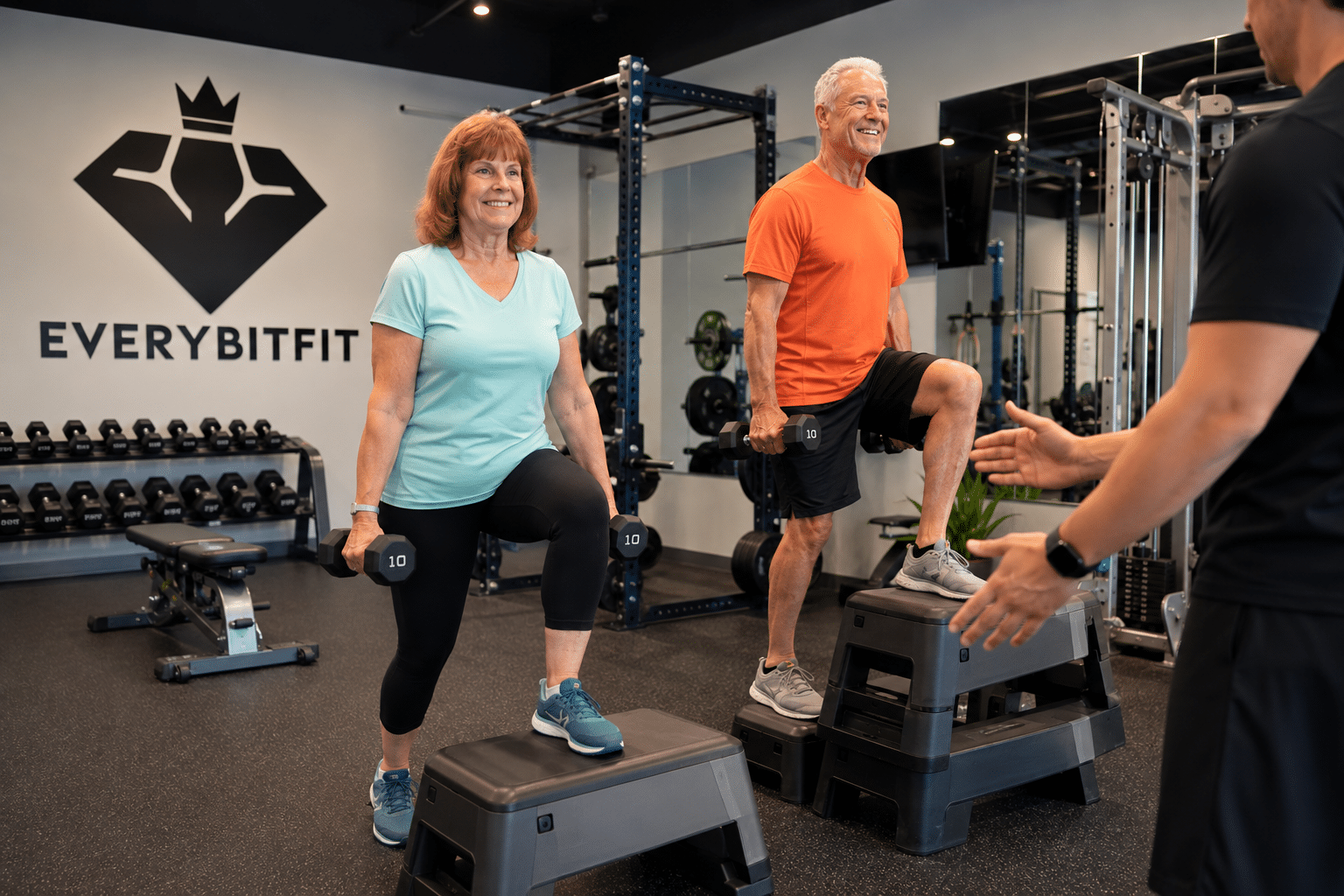
3. Step-ups for single-leg strength. Using a sturdy step or low bench, step up with one leg and fully extend before lowering back down. This weight-bearing movement loads your hips and legs while challenging balance. Alternate legs for 10 repetitions per side, 2–3 times weekly.
4. Wall push-ups progressing to incline push-ups. Your wrists are a common fracture site with osteoporosis. Push-ups load the bones of your arms and wrists while building upper body strength. Start against a wall, progress to a countertop, then eventually a bench as you get stronger. This exact progression is what our trainers build into every client's program.
5. Daily walking with purpose. Aim for 30 minutes of brisk walking most days. Add hills or stairs when possible — the greater the impact and effort, the stronger the bone-building signal. Walking is the foundation of weight-bearing exercise, accessible to nearly everyone.
For nutrition, the Bone Health and Osteoporosis Foundation recommends adults over 50 consume 1,200 mg of calcium daily (from food first, supplements if needed) and 800–1,000 IU of vitamin D. Check out our Diets & Recipes page for meal ideas that support bone health.
Can You Rebuild Bone Density After 60?
Yes — research consistently shows that bone density can improve at any age with the right exercise stimulus and nutritional support. A 2017 study in the Journal of Bone and Mineral Research demonstrated that women aged 58–70 increased spine and hip bone density through twice-weekly high-intensity resistance training over 8 months. The key is progressive overload: gradually challenging your bones beyond their current capacity so they adapt by getting stronger.
At Everybitfit, our active adults and seniors program is designed specifically for this — safe, supervised strength training that systematically increases load over time. You won't be handed a generic workout and left to figure it out alone.
What Exercises Should You Avoid With Osteoporosis?
If you've been diagnosed with osteoporosis, certain movements increase your fracture risk and should be avoided or modified. These include high-impact activities like running or jumping (unless cleared by your physician), exercises involving spinal flexion under load (like weighted sit-ups or toe touches), and movements that involve twisting the spine forcefully. Golf and tennis require careful form consideration due to the rotational forces on the spine.
This is exactly why personalized training matters for bone health. At Everybitfit, your trainer builds a program that delivers bone-building benefits while respecting your limitations. We know which modifications keep you safe and which exercises give you the most benefit for your specific situation.
How Long Does It Take to Improve Bone Density With Exercise?
Bone remodeling is a slow process — most research shows measurable improvements in bone density after 6–12 months of consistent, progressive resistance training. You may notice improvements in strength, balance, and confidence within weeks, but the structural changes to your bones take time. The critical factor is consistency: bones respond to regular, repeated loading, not occasional workouts.
This is why our trainers at Everybitfit focus on building sustainable habits, not short-term intensity. The Free Fitness Strategy + Workout gives you 5 private sessions to establish proper form, learn the right exercises for your body, and experience what personalized training delivers.
Conclusion
Your bones are waiting for you to give them a reason to get stronger. With the right combination of weight-bearing exercise, resistance training, and nutritional support, you can slow bone loss, reduce fracture risk, and build the strength and confidence to stay active for decades to come. The personalized, supervised approach matters — especially when you're protecting the foundation your body stands on.
Take the first step today. Call (602) 743-6867 or claim your Free Fitness Strategy + Workout to experience what bone-density training looks like when it's designed specifically for you. No contracts, 30-day money-back guarantee, and your first workout is free.